Welcome to MTH 2003 – Precalculus & Elements of Calculus 1A!
This course will integrate material from precalculus with introductory topics from applied calculus, including a detailed study of functions, limits and continuity, the circle, tangent lines, rates of change, differentiation of algebraic functions, matrices and linear systems of equations. Applications from economics and finance will be included, and the use of the TI 89/92 calculator will be required. (Not open to students who have completed MTH 2000, 2001, 2205, 2206, 2207, 2610, 2630, or any course at the 3000 level or above.)
*Note that this syllabus is subject to changes throughout the semester.
LEARNING GOALS OF THE COURSE
Upon completion of this course, students will be able to:
- Represent functions algebraically and graphically.
- Compute limits of functions, and use limits to determine the derivative of a function.
- Use appropriate theorems to determine derivatives of algebraic functions.
- Interpret the derivative as a rate of change, and apply this interpretation to other disciplines.
- Perform algebraic manipulations with matrices. Apply matrix operations to analyze systems of linear equations and determine solutions when they exist.
- Use a graphing calculator to perform various calculations occurring in precalculus and calculus.
PATHWAYS LEARNING OUTCOMES
This course satisfies the Mathematical and Quantitative Reasoning requirement for the Pathways Required Core. Upon completion of this course, students will be able to:
- Interpret and draw appropriate inferences from quantitative representations, such as formulas, graphs, or tables.
- Use algebraic, numerical, graphical, or statistical methods to draw accurate conclusions and solve mathematical problems.
- Represent quantitative problems expressed in natural language in a suitable mathematical format.
- Effectively communicate quantitative analysis or solutions to mathematical problems in written or oral form.
- Evaluate solutions to problems for reasonableness using a variety of means, including informed estimation.
- Apply mathematical methods to problems in other fields of study.
REQUIRED MATERIALS
Textbook: Gordon, Wang and Materowski, Applied Calculus for Business, Economics and Finance, Second Edition, Pearson, 2015.
Graphing calculator: Texas Instruments TI-89 or TI-92 Plus.
GRADING
- Weekly Homework (10%)
- Graded homework will be done online through the MyMathLab system. You may access MyMathLab by clicking on the link on the Brightspace site for this section. It is your responsibility to check the due dates of all assignments and to complete the assignments before this date! MyMathLab might be busy during high traffic hours, so please be advised to finish your homework well before the deadline. No extensions will be granted on any MyMathLab assignment.
- In addition to the assigned MyMathLab problems, suggested homework problems from the book are posted on the department syllabus. Although, these problems will not be graded, they are representative of the kinds of problems you will be expected to know how to do and are similar to the quiz and test problems.
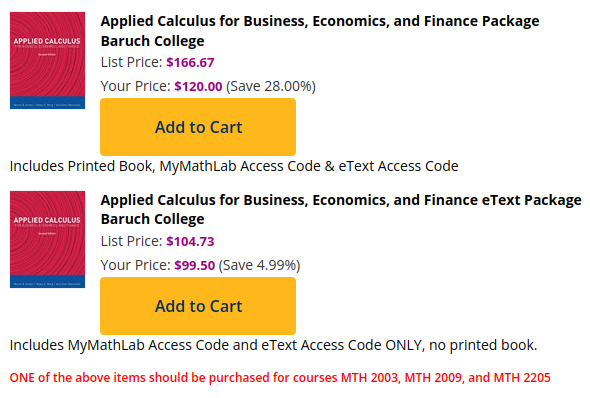
- To purchase your reduced-price course material, visit MyPearson Store , which includes a 24-month access code for the online homework. To log in, use the following credentials:
- The username is pearson
- The password is welcome2
- After you have logged in, choose one of the items in the left-hand column and click on “Add to Cart” to proceed to purchase.
- Note that your material, including the physical access code, will be shipped in the mail after you complete the purchase. Do not wait to purchase your course material!
- Quizzes (9%)
- Several quizzes will be given throughout the semester. You should expect at least one quiz each week. Each quiz will be given near the end of the class and will last between 5 and 10 minutes. In order to do well on the quizzes, it will be important that you keep abreast of the work for the course and be prepared in each class. At the end of the semester, I will drop your lowest quiz score before calculating your grade.
- Prelim Exams (51%)
- Three preliminary exams (17% each) will be given during the semester. All tests will be announced at least a week in advance. Two of the exams will be given before the final drop deadline of Thursday, November 6.
- Final Exam (30%)
- The final exam will be given on the date and time assigned to this course — Wednesday, December 17, from 8 to 10 AM.
- Any student who is absent from the final examination is given a grade of F or WU for the course pursuant to the grade definitions as stated in the Undergraduate Bulletin. Per department policy, any student who receives a grade below 50% on the final exam or who has an overall course grade below 60% will receive a grade of F in the course. There are no exceptions to his policy.
- No makeup exams will be approved except for extremely urgent situations. Exams and worksheets are closed book. Wireless devices such as PDAs, laptops, and cell phones may not be used during class.
- Cheating in any form will not be tolerated. Anyone caught cheating on an examination or quiz will be given a grade of 0 for the assignment. Repeated infractions will lead to a grade of F for the course.
| Letter Grade | Grade Point Equivalent | Percentage Equivalent |
|---|---|---|
| A | 4.0 | 93.0 – 100.0 |
| A- | 3.7 | 90.0 – 92.9 |
| B+ | 3.3 | 87.1 – 89.9 |
| B | 3.0 | 83.0 – 87.0 |
| B- | 2.7 | 80.0 – 82.9 |
| C+ | 2.3 | 77.1 – 79.9 |
| C | 2.0 | 73.0 – 77.0 |
| C- | 1.7 | 70.1 – 72.9 |
| D+ | 1.3 | 67.1 – 69.9 |
| D | 1.0 | 60.0 – 67.0 |
| F | 0.0 | Below 60.0 |

